



WOOCOMMERCE TO SHOPIFY MIGRATION
WooCommerce to Shopify, with your rankings intact
Leave plugin updates and server bills behind. We rebuild your store on Shopify, move products, customers and orders cleanly, and protect every URL that ranks.

 Shopify
WOOCOMMERCE → SHOPIFY
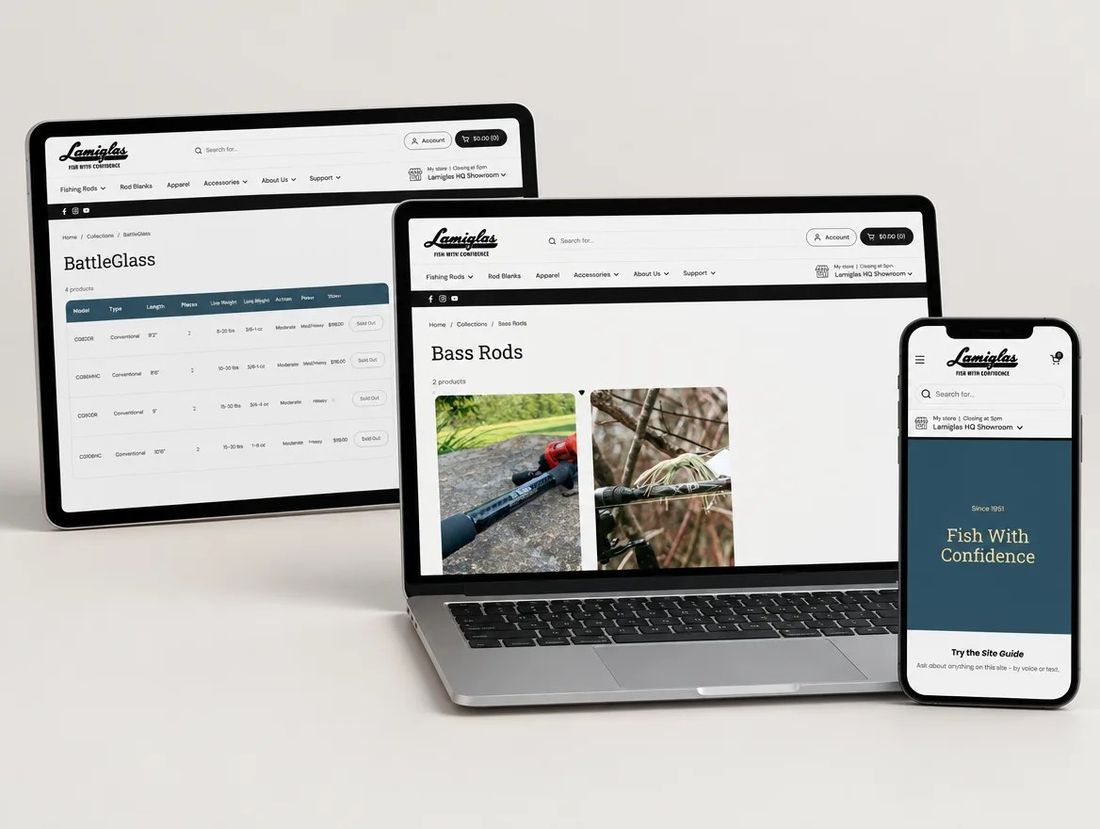
Lamiglas · 2,400 URLs · 1,200 SKUs
TYPICAL TIMELINE
4 to 8 weeks for a typical DTC store
COST
Quoted after the catalog & URL inventory
SEO RISK
Medium — WooCommerce and Shopify structure URLs differently
MOVES CLEANLY
Products, variants, customers, orders and reviews
MUST BE REBUILT
Theme, checkout and plugin features
IN SHORT · CHECKED OCTOBER 2026 AGAINST WOOCOMMERCE AND SHOPIFY DOCS
A WooCommerce to Shopify migration is a rebuild plus a data move. WooCommerce exports products, customers and orders as CSV, which we clean and import into Shopify or push through the Admin API. Themes and plugins don’t carry over, so the storefront is rebuilt and plugin features are replaced. Every old URL is kept or gets a one-to-one 301 before launch.
WHY TEAMS MOVE
Why teams leave WooCommerce for Shopify
01
Plugins and servers to babysit
WooCommerce means a host, a theme and a dozen plugins that each need updating, and some conflict. Shopify folds most of that into the platform.
02
Checkout you can’t fully trust
A self-hosted checkout is a payment and PCI surface you own. Shopify’s checkout is hosted, fast, and converts out of the box.
03
Speed and Core Web Vitals
Heavy themes and stacked plugins make WooCommerce slow unless someone manages it. Shopify’s hosting starts from a better place.
04
Scaling and reliability
Traffic spikes and flash sales take tuning on WooCommerce. Shopify handles the load, so launches don’t fall over.
OLD VS NEW
WooCommerce vs Shopify, for this move

WooCommerce

Shopify
Upkeep
Host, theme and plugin updates are yours
Hosting, security and updates handled by Shopify
Editing
Admin plus a page builder; many changes need a developer
Theme editor and sections; merchants edit layouts themselves
Catalog & orders
WordPress posts plus WooCommerce products and orders
Native products, variants, customers and orders
Checkout
Self-hosted checkout you secure and maintain
Hosted, high-converting checkout, PCI handled
Apps & extending
A huge but uneven plugin ecosystem
Vetted App Store, Functions and custom code
Redirects
A plugin or server config
Built-in URL redirects, imported from a CSV
WHAT MOVES, WHAT DOESN’T
What comes across from WooCommerce
WooCommerce exports your data, not your design. Plan for a rebuild of the storefront and a careful move of everything you’ve sold.
Products & variants
Export products, variants, prices and inventory as CSV; we clean and import, or push via the Admin API.
Customers & orders
Customers and historical orders import with an app or the API, with addresses and tags preserved.
Content & CMS
WordPress posts and pages become Shopify blog posts and pages; page-builder markup is cleaned or rebuilt.
SEO
Titles, descriptions and redirects are set per page and per product; the 301 map imports from CSV.
Theme & storefront
WooCommerce themes don’t carry over; the storefront is rebuilt on a Shopify 2.0 theme.
Checkout & payments
Checkout moves to Shopify’s hosted checkout; payment and tax settings are reconfigured.
Plugins & extensions
Each plugin is matched to a Shopify app, a native feature, or custom code; gaps are flagged at the audit.
CONTENT MODEL
How WooCommerce content maps to Shopify
WOOCOMMERCE · BEFORE
Products
WooCommerce products with attributes and variations, stored in WordPress.
SHOPIFY · AFTER
Products & variants
Shopify products with options and variants, imported from CSV or the API.
WOOCOMMERCE · BEFORE
Categories & tags
Product categories and tags that group your catalog.
SHOPIFY · AFTER
Collections
Shopify collections, manual and automated, with the same grouping.
WOOCOMMERCE · BEFORE
Customers
WooCommerce customers with addresses and order history.
SHOPIFY · AFTER
Customers
Shopify customers with addresses, tags and order history preserved.
WOOCOMMERCE · BEFORE
Posts & pages
WordPress posts and pages, often with page-builder markup.
SHOPIFY · AFTER
Blog & pages
Shopify blog posts and pages, rebuilt from the cleaned export.
PROCESS AND TIMELINE
How we move a WooCommerce store to Shopify
Our usual order for a DTC store with a blog. Bigger catalogs and B2B take longer.
1
WEEK 1Audit & inventory
Crawl every URL, export the catalog, customers and orders, and record titles, descriptions and rankings. This list decides what must not move.
2
WEEK 1Redirect map & data model
Decide every URL’s fate (keep, 301 or retire) and map products, collections and content to Shopify before anything is designed.
3
WEEKS 2–4Design system & rebuild
Build type, color and spacing tokens and reusable sections in Shopify, then the templates and collection pages.
4
WEEKS 4–5Data migration
Clean the WooCommerce export, import products, customers and orders via CSV or the API, then check items and images by hand.
5
WEEKS 5–6SEO parity & QA
Set titles, descriptions, alt text and schema, import the 301 map, and test every form, link and redirect on a preview theme.
6
LAUNCH + 4 WEEKSLaunch & watch
Launch early in the week, submit the sitemap, then watch 404s, indexing and rankings daily against the baseline.
A MIGRATION WE'VE SHIPPED
WooCommerce to Shopify, for a heritage rod maker.
Lamiglas
We moved 2,400 URLs and 1,200 SKUs from WooCommerce to Shopify and brought the dealers online.
SEO SAFETY
The pre-launch checklist
Rankings are lost three ways: broken URLs, missing on-page signals, crawl problems. These four stages close all three.
STAGE 1
Before the build
- URL inventory, every live URL listed by template
- Redirect map, one 301 per changed URL
- Trailing slashes and product URL rules
- Category and tag archives kept or redirected
STAGE 2
During the build
- Titles and descriptions per page and product
- Canonicals and structured data
- Image alt text
- A clean, complete sitemap
STAGE 3
Before launch
- 301 map imported and tested
- Forms, links and redirects tested on a preview theme
STAGE 4
After launch
- Submit the sitemap and request indexing
- Watch 404s, indexing and rankings daily
FREE MIGRATION PLANNER
Plan your WooCommerce to Shopify redirects
Enter your store to list every URL, see which keep their path, and get the 301 redirect map.
Run the planner →FREE SEO & AEO CHECKER
Check your new Shopify store for AI answers
See if ChatGPT, Claude, Perplexity and Google AI Overviews can find, read and cite your store.
Run the checker →FAQ
What WooCommerce teams worry about

Not sure which move you need?
We’ll look at your store on a 30-minute call.
Book a callWill we lose our Google rankings?
Not if the redirects and on-page signals are done right. Every changed URL gets a one-to-one 301, and we track rankings, 404s and indexing daily against the pre-launch baseline.
How long does a WooCommerce to Shopify migration take?
4 to 8 weeks for a typical DTC store. Bigger catalogs and B2B take longer; we confirm the timeline after the catalog and URL audit.
How much does a WooCommerce migration cost?
It's quoted after the catalog and URL inventory, because catalog size, plugins to replace and design scope drive the effort.
Will our product URLs change?
Usually, because WooCommerce and Shopify structure URLs differently. Each changed URL gets a one-to-one 301 redirect, imported from a CSV before launch.
Can you redesign the store during the migration?
Yes. WooCommerce themes don't carry over, so the storefront is rebuilt anyway and most teams redesign as part of the move.
Last updated
You've reached the end, so now…
Tell us what you're selling.
Send us your store. Within one business day you get a short Loom from a senior: the three things we'd fix first, what it would cost, and whether we're the right team for it.
- No pitch deck, no discovery-call theatre
- You keep the audit whether or not you hire us
- Fixed-scope quotes, no hourly surprises

Prefer to talk? Book 20 minutes with Haniel or call +1 855-764-4977